(originally published on www.thelipstickchronicles.typepad.com/11.26.07
We’re on the road. We do this every November and April, close up our small restaurant in the small village of Woodstock, Vermont and point ourselves North, South, East, or West. In April, we are always East. We land in Italy for a time to eat, to drink, to be inspired. In November, we could be anywhere. We have found ourselves in LA, Buenos Aires, Montreal, New York, Oregon, Paris. This time we are in New Orleans.
We have long wanted to come here. My family lived here years ago, and Caleb’s aunt and uncle still do. We are sad to have missed the New Orleans before The Storm, but we are happy to finally arrive, to see the proud and elegant city as she gets herself back on her pins. The sections of town nearer the river are looking quite fine, houses freshly painted, gardens tended, the remaining live oak looking broad and powerful, thriving. Other sections of town, those farther from the river, especially those in the infamous 9th ward, are still vacant and ghostly. Windows are boarded up or are filled with jagged broken glass, the water lines still exist on the sides of house, the yards are wild with pink oleander, grasses, and the climbing blue plumbago. The stench of rot and mold lingers. Walls still are marked with signs left from the National Guard. 1 Dead in Attic.
We’ve come to New Orleans on a pilgrimmage: to eat, to taste Cajun, Creole, and Soul food renditions. We compile a list, not of all the usual favorites and “must-eats”, but of smaller places, those who opened as little as ten days after Katrina because they couldn’t stand by and stop cooking for their city. They knew they needed to feed their people and all those who came to volunteer their help in those first harrowing months after the hurricane. We’ve heard stories of Paul Prudhomme setting up in a parking lot with propane burners and cooking kettles of gumbo, or Donald Link opening Herbsaint with only 6 people when usually there is a team of 45. We heard that old favorites opened for business even when it was nearly impossible: Upperline, Dooky Chase, then Brigsten’s. These are the places at which we choose to dine on our first visit.
Dining at Dooky Chase is tops on our list. Open since 1941 in Tréme, the first historical section of town to be inhabited by freed slaves, we are eager to eat their classic dishes: fried chicken, red beans and rice, stewed ocra, green beans with dirty onions. Leah Chase, the daughter of the original Dooky, has been cooking at this restaurant since the Fifties. We have always been awed and inspired by those stalwart cooks who keep at it day after day.
But Dooky Chase is currently closed. The message on their answering machine says they hope to re-open at the beginning of November, and in the meantime they are serving take-out Tuesday-Sundays from 11:30-7:00. We grab at the chance after an “early” lunch of fresh oysters and fried softshell crab at Casamentos (some days we have to eat throughout the day in order to hit every one of our destinations), and pick up a “late” lunch from Dooky Chase.
It is a charmed visit, one full of stories and good cheer, though as with many things in New Orleans these days, there is a melancholy note. We walk in the side door and it’s clear they have been under significant construction. No one is about and we yell, “Hello! Anyone here?” Someone shouts back from the kitchen. We are greeted warmly and given a take-out menu. We order. We are offered a seat in the newly painted bar while we wait. A handsome young man brings us water and iced-t served in glasses and with lemon. We tell him this didn’t seem much like take-out service. He smiles genuinely and says, “Well, I’m hoping you will come back again.”
Like so many others, Dooky Chase has fallen on some hard luck since Katrina. Two feet of water flooded the building, and they have been renovating and restoring ever since. The restaurant is home to an extensive African-American art collection, and fortunately they were able to get the work out and into storage up in Baton Rouge before it was lost to the elements or looting. Mr. Chase, Miss Leah Chase’s husband, takes us on a tour of the refurbished dining rooms. Miss Chase is conducting an interview in a pretty, yellow room with French chairs and pale yellow brocade. She holds our hands in her own upon introduction and is enthusiastic about re-opening, but you can also tell she is flat-out. Finding employees seems to be the biggest problem facing the restaurant these days. There are not enough people left in the city. Too many have moved away because they lost everything, and needed to start somewhere fresh instead of waiting, and waiting, and waiting to pick up somewhere far behind where they left off.
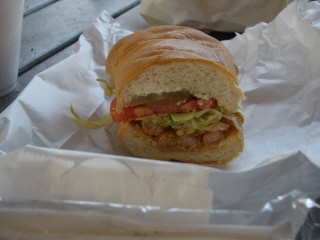
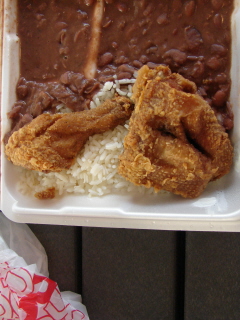
Mr. Chase takes us into the red room, and the private green room, again elegant and old world as if it’s still 1955 and New Orleans might still part of New France. The Empire style would have made Napoleon proud. When our fried chicken, and red beans and rice, and stewed vegetables, and fried shrimp sandwich are all ready, Mr. Chase brings us back to the bar with its bright green walls with black and white trim and a terrific painting of Louis Armstrong. He notices that Caleb is wearing a t-shirt from Brazil and begins to scat a little bossanova number. His voice is pure and tremulous and his smile is true. He encourages Caleb to join in, and he does so, tentatively at first, but then gaining momentum. I keep silent and listen as I can’t sing. When they are done, we all clap and Caleb asks, “Now, what would we have sung if I had been wearing my Italy t-shirt?” And they are off again, an old black man, and a younger white one, dipping and reaching for notes from that old classic “Volare”. To fly, says that song in translation, I fear this dream will never return, my hands and my face are colored in blue, suddenly I was pulled away by the wind and soared into the endless sky…”
We take our carefully packed picnic to Audobon Park and sit under a pergola at a table and lay out our treasure. The dishes are beautiful in their simplicity and spicy, savory aromas; they need no translation as they are perfectly understood. The fried chicken melts on the tongue, and the candied yams have sweet and texture. We look out over the green park in evening, at the people jogging, mothers and fathers teaching children to ride their bikes, two friends walking a dog, the man who comes to feed the ducks. Here’s to the New Orleans of old, and all that will be new. Here’s to the return of the people, and their unfailing spirit because all that wind, and rain, and devastation can’t take that away.